In Activity 4 we experimented with how light effected the temperature of a miniature earth. Our model of Earth was made from a 2 liter pop bottle. We had six bottles, two with water, two with sand, and two with soil. One out of every category had paint on the top to simulate clouds to see how clouds would change the effect the light had on the substances temperature. This project tought us how clouds in the air effect how the sunlight change the temperature of the Earth. Therefore, I can now tell that clouds have an impact on the sun rays hitting the Earth and slightly effect how the rate at which the ocean will heat due to sunlight. Knowing this I can more easily determine how ocean temperature will be effected due to sunlight.
http://www.livescience.com/environment/050505_earth_bright.html
http://www.phy6.org/stargaze/Sun1lite.htm
Friday, December 15, 2006

Activity 2
In activity 2 we recorded and observed the weather for 7 days and created graphs out the data. This project helped us better to understand patterns and occurences in weather. It also kept us updated in current weather for our area and helped us to determine what we can expect from upcoming days. Overall this project gave me a better understanding of how weather and temperature can change and apapt to different times of the year or rotation of the eath to the sun. This will help me understand better how ocean temperatures are ultimately determined.
www.weatherchannel.com
www.weatherbug.com
www.weatherchannel.com
www.weatherbug.com
Monday, December 11, 2006
Major Temperature Rise in the Arctic
According to an article on ABC News online German scientists probing global warming say they have detected a major temperature rise in the Arctic Ocean this year and linked it to a progressive shrinking of the region's sea ice. Temperatures recorded this year in the upper 500 metres of sea in the Fram Strait - the gap between Greenland and the Norwegian island of Spitsbergen - were up to 0.6 C higher than in 2003, they said. This is an obvious sign of temperature increase in oceans.
http://www.abc.net.au/news/newsitems/200408/s1187058.htm
http://www.abc.net.au/news/newsitems/200408/s1187058.htm
Wednesday, December 6, 2006
Ocean Temp. and Global Warming
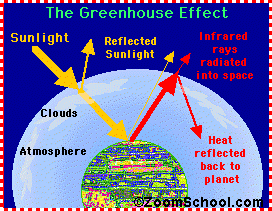
According to climatecrisis.net, Carbon dioxide and other gases warm the surface of the planet naturally by trapping solar heat in the atmosphere. This is a good thing because it keeps our planet habitable. However, by burning fossil fuels such as coal, gas and oil and clearing forests we have dramatically increased the amount of carbon dioxide in the Earth’s atmosphere and temperatures are rising.
The vast majority of scientists agree that global warming is real, it’s already happening and that it is the result of our activities and not a natural occurrence.1 The evidence is overwhelming and undeniable.
We’re already seeing changes. Glaciers are melting, plants and animals are being forced from their habitat, and the number of severe storms and droughts is increasing.
According to this report many things have already happened because of this, The number of Category 4 and 5 hurricanes has almost doubled in the last 30 years. Malaria has spread to higher altitudes in places like the Colombian Andes, 7,000 feet above sea level. The flow of ice from glaciers in Greenland has more than doubled over the past decade. At least 279 species of plants and animals are already responding to global warming, moving closer to the poles. ]
Also many things are still expected to happen such as, Deaths from global warming will double in just 25 years -- to 300,000 people a year. Global sea levels could rise by more than 20 feet with the loss of shelf ice in Greenland and Antarctica, devastating coastal areas worldwide. Heat waves will be more frequent and more intense. Droughts and wildfires will occur more often. The Arctic Ocean could be ice free in summer by 2050. And More than a million species worldwide could be driven to extinction by 2050.
Global warming could possibly become a huge cause for ocean temperatures to rise and it could bring about a lot of negative consequences.
Activity 1

In this assignemnt we recorded temperature change in three different substances due to light. For the substances we had light colored sand, soil, and water. For fifteen minutes we recorded, with thermometers, the temperature change for for the substances with light being applied and then for another fifteen minutes we recorded the temperature change without light. The first stage(first 15 minutes) was called the heating stage and the second stage was the cooling stage. This assignment helped me to realize what a big difference light makes in the temperature of the Earth. This knowledge will help me determine how oceans gain and lose temperature.
http://visibleearth.nasa.gov/view_set.php?categoryID=991
http://wps.prenhall.com/esm_lutgens_atmosphere_8/0,6585,263598-,00.html
Monday, December 4, 2006
Atmospheric Moisture Advection and Precipitation

In this assignment we learned about how wind flow relates to the occurence of precipitation. Wind flow pushes moisture in the air horizontally and moves into regions with less precipitation where it then cools down and falls to the Earth. This relates to ocean temperatures because it can help me determine, by the amount of precipitation, temperatures in water.
http://ams.allenpress.com
http://ww2010.atmos.uiuc.edu/(Gh)/guides/mtr/hyd/home.rxml
Subscribe to:
Posts (Atom)